Conventional forest glues similar Titebond are water-based, and they rely on penetrating into the grain of the wood, and so (once the water has evaporated) hardening, leaving a bail that is in many instances stronger than the forest itself.
The Trouble:
Many tropical hardwoods are so oily or resinous that they're practically waterproof. Information technology would then stand to reason that if conventional woods glues need to penetrate into the wood in order to obtain a potent bond, then these oily woods would present a claiming in gluing.
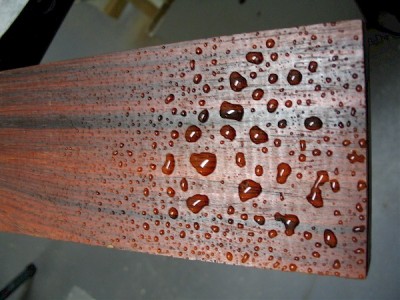
Water beads up on the surface of Cocobolo.
Above you can see a picture of untreated, raw Cocobolo, which was misted with a spray bottle full of regular water. Information technology should exist plain to see that this wood, (forth with a handful of other tropical species), announced to exist nearly waterproof.
They're technically not waterproof: since all woods, (even the Cocobolo pictured above), contains some degree of moisture that changes depending upon the relative humidity of the surrounding air. But for most intents and purposes, in the short amount of time that is elapsed in the gluing process, so little of the gum sinks downwardly into the wood grain that it is substantially waterproof, or possibly more than accurately, glueproof.
Between different types of wood, and even within the same species of woods, there can be a lot of variability in oil/resin content, and gluing success/difficulty. Sometimes an oily wood can exist glued with regular yellow glue with no bug, and in the adjacent case, the mucilage joint volition nearly fall apart on its own.
Information technology would exist preferable if the objects which nosotros are building would stay in one piece!
So what tin can be done most this unpredictable nature of forest?
Some Solutions:
Please note that these are some solutions that can help requite consistent results in gluing troublesome woods; but it is by no means a cure-all that is guaranteed to work every time, with all wood species and with all types of forest joints. On the whole, employing these tips should result in generally stronger, longer-lasting glue joints in oily forest..
1.) Wipe the woods surface with a solvent prior to gluing.
Since the primary trouble that tropical woods present in gluing is their oiliness, (with density probably being the second biggest trouble), any of these natural oils and resins that yous tin can remove from the wood surface will assistance the mucilage adhere that much better.
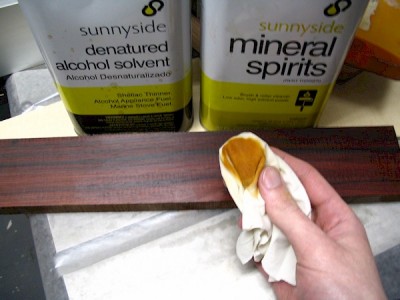
While it'due south not a cure-all, wiping the wood with a solvent first goes a long way. But you lot accept to be sure of two things: commencement, you should try to glue the pieces of forest to be joined as soon equally possible after the solvent has evaporated from the wood surface. This is because the wood'southward oils will tend to migrate dorsum to the surface of the woods where you lot removed some of the oils. Secondly, you have to be sure that the solvent you're using is actually dissolving and removing the wood's oils. A good fashion to gauge this is past checking the towel that you're using to wipe the solvent to see if it'south changed to the wood'south color.
A solvent should lift surface oils from the wood.
ii.) Sand the wood to help open up upwards the grain.
3.) Use synthetic, non-water-based glues.
Since water is repelled by the wood's oils, using water-based glues like Titebond® can pose problems—though Titebond® Ii or Iii are normally better at gluing oily forest than Titebond® Original. Instead, apply glues that aren't water based, and/or glues that can bond a wider diversity of materials like plastics and other non-porous surfaces (since that's practically what we're doing with these exotic woods anyways).
Some examples of such adhesives would be: polyurethane glues (i.e. Gorilla Glue®, etc.), 2-role epoxies (i.e. West System®, System Iii®, etc.) and, if the parts to be glued are adequately small, cyanoacrylate glues (i.e. "super" gum, Hot Stuff®, etc.).Besides, if using a polyurethane-based glue, it's important to moisture the woods surface with water just before gluing. Polyurethane is activated by moisture, and it may not receive enough moisture to cure properly if the woods has been kiln-dried and is very depression in moisture content.
A List of Troublesome Woods:
Wood
Gluing Notes
Bubinga
High density, airtight pores, and natural oils tin can cause problems with glue penetration.
Bulletwood
High density and moderately oily.
Cocobolo
Very high oil content and high density.
Cumaru
High oil content and high density.
East Indian Rosewood
High oil content and medium/high density.
Ebonies
Some oil present, along with very high densities.
Ekki
High density and moderately oily.
Goncalo Alves
High density and natural oils foreclose water absorption.
Greenheart
Loftier density and natural oils.
Honduran Rosewood
High oil content and high density.
Ipe
Reportedly very difficult to glue in exterior applications, peculiarly for the long term.
Katalox
Very loftier density, along with natural oils.
Kingwood
Very high oil content and high density.
Lignum Vitae
Extremely loftier oil content and density can pose gluing challenges.
Osage Orange
Oils present can requite gluing problems.
Purpleheart
High oil content and high density.
Rosewoods
Typically very oily and very dense.
Santos Mahogany
High density and moderately oily.
Teak
Oils/resins can present challenges in outdoor applications.
Verawood
Extremely high oil content and density tin pose gluing challenges.
Meet as well:
Finishing Exotic and Tropical Hardwoods
Preventing Colour Changes in Exotic Forest
Are you an aspiring wood nerd?
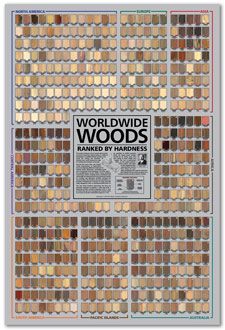
The affiche,Worldwide Wood, Ranked past Hardness, should exist required reading for anyone enrolled in the school of wood nerdery. I take amassed over 500 wood species on a unmarried poster, arranged into 8 major geographic regions, with each wood sorted and ranked according to its Janka hardness. Each wood has been meticulously documented and photographed, listed with its Janka hardness value (in lbf) and geographic and global hardness rankings. Consider this: the venerable Blood-red Oak (Quercus rubra) sits at but #33 in North America and #278 worldwide for hardness! Aspiring wood nerds be advised: your syllabus may be calling for Worldwide Wood as part of your next assignment!
Do You Have To Clean Off Old Glue Before Repairing Wood,




 The affiche,Worldwide Wood, Ranked past Hardness, should exist required reading for anyone enrolled in the school of wood nerdery. I take amassed over 500 wood species on a unmarried poster, arranged into 8 major geographic regions, with each wood sorted and ranked according to its Janka hardness. Each wood has been meticulously documented and photographed, listed with its Janka hardness value (in lbf) and geographic and global hardness rankings. Consider this: the venerable Blood-red Oak (Quercus rubra) sits at but #33 in North America and #278 worldwide for hardness! Aspiring wood nerds be advised: your syllabus may be calling for Worldwide Wood as part of your next assignment!
0 Response to "Do You Have To Clean Off Old Glue Before Repairing Wood"
Post a Comment